In 2025, through an effort led by Holgate resident John Prochazka, the HTA repaired, refurbished and deployed over 100 new fly traps, gaining recognition in the Sandpaper and other NJ media. What is a Greenhead Fly Trap and what makes them so important to Holgate? Read the following article and you’ll know all about them.
What the heck is that thing?
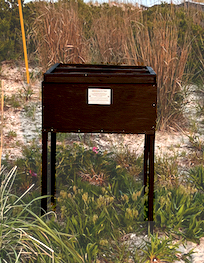
Everything you wanted to know about Holgate’s Greenhead Fly Traps.
Those big, black boxes you see near the marshes and around the township may look like big black boxes to you, but to a nasty, literally blood-sucking greenhead fly, it’s a cow. Or a horse. Or some other large, fleshy, blood-containing mammal.
Now you’d think that with those 6,000 or so beady little eyes that flies have, they’d see it was just a large wooden box with a mesh screen on top. But that shape, when combined with the scent of the bait inside, convinces them that it’s a delectable dinner just waiting to happen.
How it works
Researchers who have devoted their lives to documenting fly behavior may not be people you want to sit next to at a porch party, but they do know that carnivorous flies tend to circle their prey before attacking. Even if that prey only has two legs. So these traps have a cone-shaped funnel underneath – which serves as an entranceway right into the trap.
Once those flies get in, they hardly ever get out. The sunlight that comes in through the mesh screen apparently attracts them upwards, and for some reason, they don’t fly back down. They just crawl around on the mesh screen, upside down, until a day or so or later, having had no food or water they simply die off. (They can’t eat the bait because it’s packed in a container that only lets the scent out.) That’s it. No pesticides. No chemicals. Nothing but Mother Nature at work.
NOTE: The sun filtering through the screen is a very important part of the system. This is why nothing should ever be placed on top of the traps.
A bite of history
For years, greenhead flies plagued the whole area around Holgate. The flies could get so bad over the summer that people would leave the beaches, stay indoors, and even choose not to come to the island in order to avoid them.
Then, about 25 years ago, a Holgate homeowner vacationing in Cape Cod happened to see hundreds of these black boxes up there. He asked what they were and how they worked, and took the idea back to the Holgate Taxpayers Association.
With that, Cliff Denker, Bill Hutson and Ted Stiles of the HTA started up Holgate’s fly trap program. Working closely with the Entomology Department of Rutgers University, they soon built a few traps of their own. Within a few summers, as the number of traps increased, it became clear that the greenhead fly population was dropping dramatically.
Seeing the results, Long Beach Township became a partner in the effort. Today, there are about 140 traps around Holgate, and a lot fewer flies than there used to be.
How you can help
Since they’re made of wood, the greenhead fly traps can take a beating from the winter weather. That’s why the HTA has created the Adopt-A-Trap Program, in which Holgate homeowners volunteer to take in a trap for the winter, and keep it safely stored in their garage or protected from the elements under a tarp.
All you need is a little protected space on your property and you can be part of the effort. There’s even an option to purchase a trap for yourself.
To find out more: email us at info@holgatetaxpayers.org or talk with one of your HTA Trustees
Greenhead Resource Links
Step by step greenhead trap building instructions